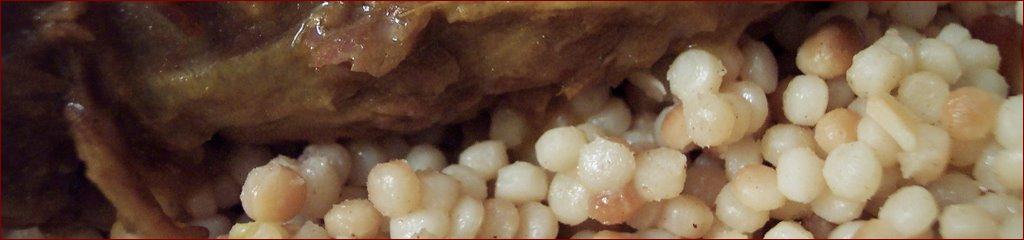
I've never been a fan of couscous, which is a shame because I love the things that get spooned over it--spicy Tunisian vegetable stews, tagines with dried fruit, sweet braises with meat falling of the bone. So imagine my joy when I
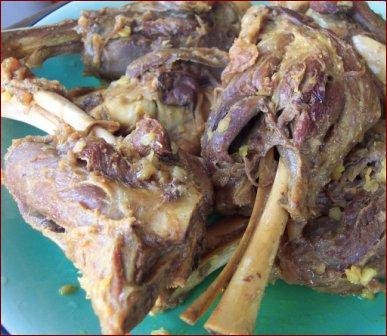
discovered Israeli couscous, which isn't couscous at all, but tiny pearls of semolina pasta. In my ongoing campaign to evangelize the stuff to the world, I present this recipe for semi-Moroccan lamb shanks with a fantastic stew-y broth, perfect for pouring over the UnCouscous. The recipe has the added benefit of being exotic, yet non-threatening--both for cooks and diners. A few of the spices are wacky, but everything else should be sitting pantry and the technique and equipment are very basic--no scary
tagines or
couscoussiers.
***
Semi-Moroccan Lamb Shanks
(slightly adapted from Aromatic Lamb-Shank Stew in
Nigella Bites)
In a large heavy-bottomed pan, heat over medium-high:
3 Tablespoons peanut oil (I added a drizzle of toasted sesame oil as well, which is virtually always an improvement)
Brown, in batches if necessary:
6 lamb shanksWhile the lamb is browning, drop into your food processor and whir to a pulp (or finely chop):
2 onions, quartered
6 cloves of garlic, peeled and smashed
When nicely browned (I'm very impatient on this step, but I do think that waiting for genuine brown crunchiness is worth it) remove shanks and set aside. Then add the onion mash to the pan, along with:
2 additonal Tablespoons peanut oil1 pinch saltWhen the onion start to brown and gets softly translucent, add:
1 Tablespoon turmeric1 teaspoon ground ginger1/4-1/2 teaspoon red pepper flakes2 teaspoons cinnamon1/4 teaspoon nutmeg (I'm sure freshly grated is better, but I can never manage find the whole nutmeg and the grater in my kitchen at once, so I always use pre-ground and it works out OK)
black pepperStir to combine the spices with the onion mash, and cook for a minute or two, until fragrant. Then add:
3 Tablespoons honey1 Tablespoon soy sauce3 Tablespoons Marsala wine, sherry, port or whatever you've got on hand
The honey will bubble alarmingly, but when you add the soy (of all things) there will be a moment of magical kitchen alchemy when the contents of your pot suddenly smell like Moroccan stew.
Dump the lamb shanks back in and add enough
cold water to the pot to barely cover the meat. Bring to boil then cover and reduce heat to low. Simmer for 1 to 1 1/2 hours, until meat is very tender.
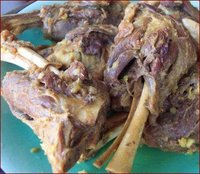
Here Nigella instrcts us to uncover the pot and add:
6 Tablespoons red lentilsAnd cook for 20 more minutes "until the lentils have softened into the sauce and the juices have reduced and thickened." This didn't happen in my pot, so I removed the now-tender lamb shanks from the pot and boiled the hell out of the juices for another 15 minutes until things really did start to "reduce and thicken." Then I dropped the meat back in and let the pot sit on a very low burner, uncovered, until it was time to eat. In retrospect, I'm not sure it matters much which route you take, but my way doesn't seem to have done any harm and the juices were just right for my taste.
Serve in a big vat, alongside a bowl of couscous, with little side dishes of toppings, like:
Toasted slivered almondsYogurtChickpea puree or hummusWhatever else appeals to you
***
Buttery Israeli Couscous(adapted from
my own recent encounter with Israeli couscous)
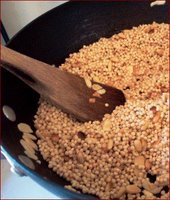
In a large dry skillet over low heat, toast:
1/2 cup pine nuts1/4 cup slivered almondsWhen nuts are beginning to turn golden, turn up the heat to medium/medium-high and add:
4 Tablespoons butterWhen the butter is melted, stir in:
3 cups Israeli couscous (also called super couscous, maftoul, or pearl couscous)
4 cardamom pods, lightly crushed
Cook for about 3 minutes, stirring, to toast the couscous, which will make little popping sounds and brown slightly.
Have ready:
6-8 cups stock, white wine, or water (I recommend using 2 cups chicken stock, and the rest water, but whatever you have will be fine)
Pour in the 2 cups of stock, and cook over medium heat until most of the liquid is absorbed. Continue to add the water slowly (about a cup at a time), allowing all the liquid be almost completely absorbed each time--think risotto.
Couscous is done when there is no floury core left, but the individual pearls still have some bite.
.jpg)
 While making this spring green pea soup last night, I was besieged by the memory of Edward Lear's nonsense poem, The Jumblies, who sing: